# Convex Arbitrage: Why Geometry Beats Height, Sensors, and Force
How inverted failure modes create security systems that get stronger under attack. When a system fails, the default response is linear: make it taller, thicker, add sensors, add AI, add enforcement. This response feels intuitive because it maps to force escalation. But force escalation rarely changes the structure of failure — it just delays it.
- Taller walls create better ladders
- Thicker walls concentrate tunneling
- Sensors add power, maintenance, and attack surfaces
- AI accelerates learning on both sides
The system remains teachable.
⸻
Convex Arbitrage: The Structural Opportunity
Convex arbitrage exploits a simple asymmetry:
Attackers must learn and repeat successful strategies. Systems can be designed so repetition makes them worse off.
Instead of fighting force with force, convex arbitrage targets the learning curve itself.
- Small attacks produce small effects
- Larger attacks produce disproportionately worse outcomes for the attacker
In finance, this is convexity. In engineering, it's failure-mode inversion.
⸻
Why Borders, Fences, and Walls Are the Perfect Target
Boundary systems concentrate three structural weaknesses:
1. Repetition – long runs of identical geometry 2. Predictability – uniform spacing and behavior 3. Binary failure – intact → breached
Once a breach works in one place, it works everywhere.
The wall teaches the attacker.
⸻
Inverting the Problem Instead of Reinforcing It
Convex arbitrage asks a different question:
What if the correct-looking attack made the system harder to defeat?
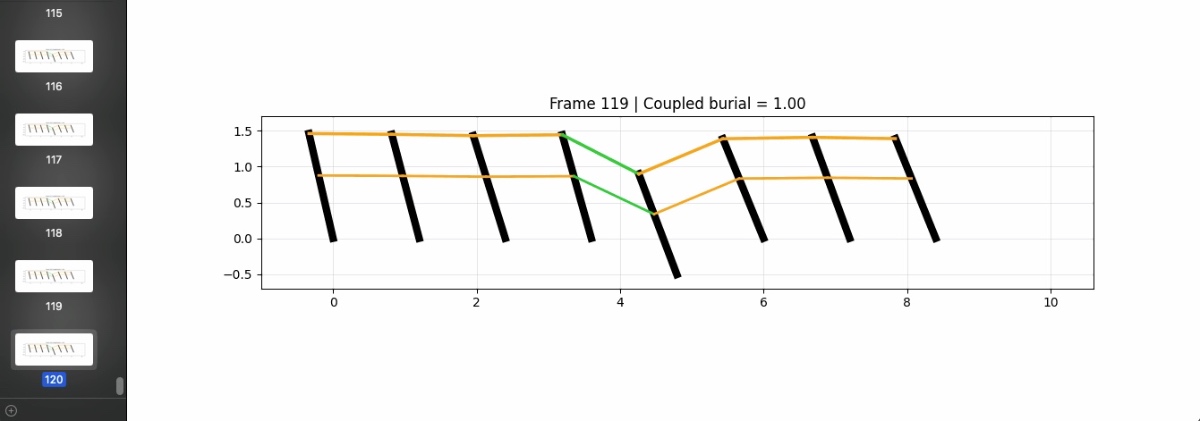
Instead of preventing failure, the system is designed so that failure produces a worse configuration.
- Excavation removes support
- Removal triggers settlement
- Settlement converts the void into new footing
To continue tunneling, an attacker must reinforce the excavation they just created.
The breach becomes underground construction under load.
That is not a shortcut.
⸻
The Payoff: Anti-Fragility
- Embedment is deeper
- Soil engagement is higher
- Structural stiffness increases
Height is restored by stacking modules at the top. No excavation. No realignment. No reconstruction.
The system improves through use.
That's convexity.
⸻
Why This Matters Beyond Borders
This is not about walls. It's about systems that refuse to teach their attackers.
- Industrial perimeter security
- Critical infrastructure protection
- Temporary or mobile barriers
- Any system where repetition is exploited
Once you see it, linear alternatives look naïve.
⸻
Read the Technical Paper
The full mechanical architecture, domain logic, and validation details are laid out in the white paper below:
📄 [Technical Specification](https://zenodo.org/records/18362032)
