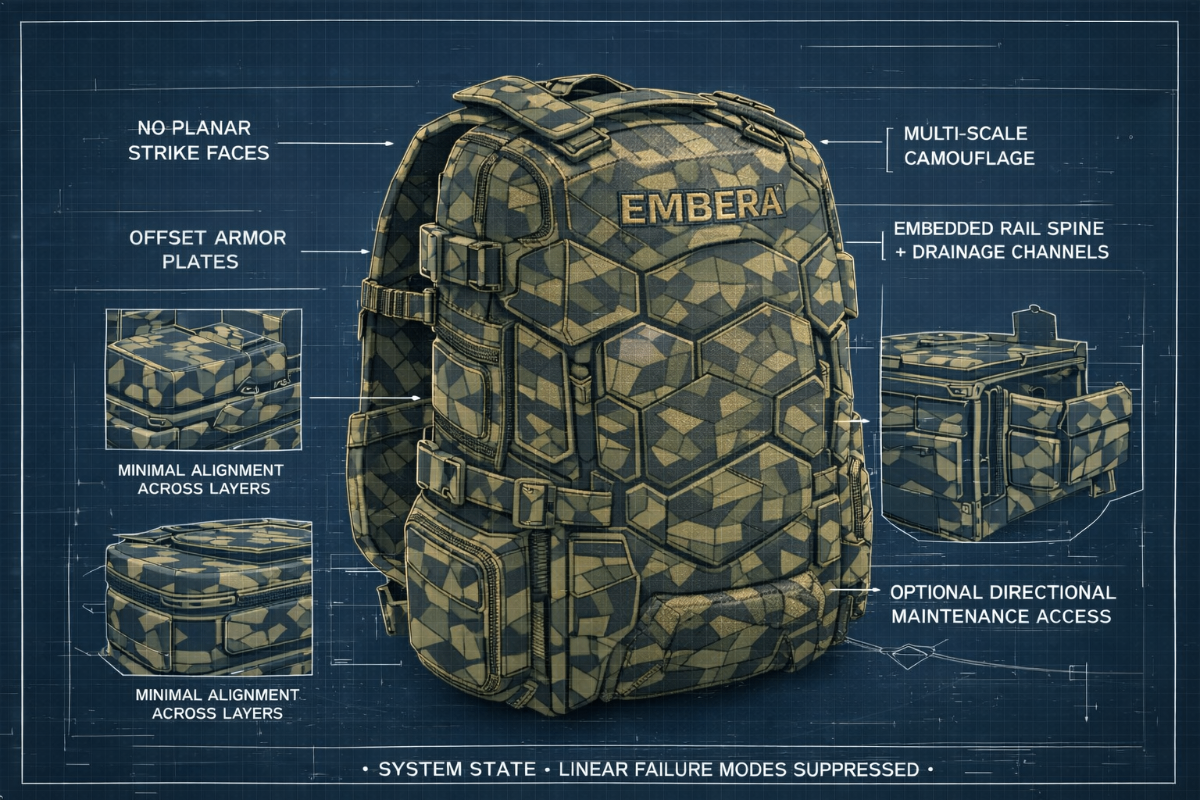
# Embera Update: Carry What Sustains You
Most outdoor gear is designed around convenience. Access to roads. Access to power. Access to resupply.
That works—right up until it doesn't.
EMBERA exists because there's a growing group of people who operate beyond infrastructure, where failure isn't annoying, it's dangerous. Hunters deep in backcountry. Field researchers. Overlanders. People preparing for grid-down scenarios. Operators who can't assume the system will be there when they need it.
The question we asked wasn't what product should we sell. It was simpler, and harder:
What do you actually need to sustain yourself when there's no grid, no road, and no store?
The answer isn't another battery. It isn't another vehicle. It's integrated systems that generate power, enable mobility, and survive real conditions without relying on fragile supply chains.
This approach is slower. It's more expensive. But it produces gear that works when there's no backup plan.
⸻
Why Most Gear Fails When It Matters
Most companies design from market research and iterate after release. Failures are discovered in the field—by customers.
We do the opposite.
If a system hasn't been validated before it's built, it doesn't ship.
That's why EMBERA products start with physics, not preferences. Thermal limits. Mechanical load paths. Environmental constraints. Human serviceability. If those aren't resolved first, no amount of clever packaging fixes the problem later.
This approach is slower. It's more expensive. But it produces gear that works when there's no backup plan.
⸻
Why Power Comes First
Power is the highest-value resource off-grid. Without it, nothing else works—no communication, no navigation, no lighting, no water purification.
That's why our first product is the Backpack Generator.
Not a backpack with a battery attached. An integrated system that generates power in the field using lipid fuels, stores it, and uses waste heat for cooking—while remaining wearable and field-serviceable.
The thermal system has already been validated across hundreds of simulation runs to ensure the user-facing surface stays within safe limits, even with a combustion source inches away. Mechanical systems are designed for redundancy, simplicity, and repair with human-scale tools.
This isn't about novelty. It's about eliminating failure modes.
⸻
A Portfolio, Not a One-Off
The backpack comes first because it should. But it isn't the destination.
The same person who needs silent, fuel-flexible power also needs silent mobility. That's why a hybrid hunting buggy follows—purpose-built for crawl-speed torque, terrain access, and mechanical determinism without software dependence.
After that: water, shelter, communication.
Each product builds on the last. Each serves the same customer. Each reduces dependence on infrastructure.
This isn't a brand chasing categories. It's a system built in the only order that makes sense.
⸻
Where We Are Now
January closed the definition phase.
The architecture is set. The customer is clear. The sequencing is locked.
What comes next is focused development: prototype builds, validation, manufacturing prep, and selective partnerships with people who understand what's actually being built here.
EMBERA isn't launching fast. It's launching correctly.
If you're someone who operates beyond infrastructure—or works with systems that must survive when assumptions fail—you'll recognize what this is.
Everything else is just execution.