Most material innovation still starts in the same place: chemistry.
We change compounds. We tweak formulations. We chase better coefficients. And when performance conflicts appear—thermal versus mechanical, acoustic versus structural—we stack systems on top of each other and accept the tradeoffs.
This works… until it doesn't.
At interfaces—where heat, vibration, sound, and load interact—chemistry-first thinking breaks down. The more domains that matter, the more complex and fragile solutions become.
We've been asking a different question:
What if material behavior isn't primarily governed by chemistry at all—but by geometry?
⸻
Energy Doesn't Care About Labels. It Follows Paths.
Heat doesn't "spread." Sound doesn't "dampen." Stress doesn't "resist."
They all move.
Each follows trajectories through space—paths defined by gradients, curvature, and boundary conditions. And the structure those trajectories move through determines what actually happens.
When geometry allows straight-line paths, energy concentrates. When geometry denies them, energy distributes.
That observation turns out to be universal.
⸻
One Geometry. Three Physics Domains.
We recently tested a single internal geometric architecture across three independent physics domains:
• Thermal (heat diffusion) • Acoustic (wave propagation) • Mechanical (impact and load distribution)
Same material. Same density. Same boundary conditions.
Only geometry changed.
What happened surprised even us.
- Routed heat preferentially in a chosen direction
- Suppressed acoustic coherence across frequency bands
- Distributed mechanical load without local stress concentration
Not three optimizations. One.
The reason is simple once you see it:
Geometry governs trajectory space.
Phonons, pressure waves, and stress fields are different carriers—but they obey the same spatial rules.
Control the paths, and you control the behavior.
⸻
This Isn't Better Material. It's a Different Design Layer.
Traditional material design asks: "What material should we choose?"
The approach we're building asks: "What behavior do we want—and what geometry produces it?"
That inversion matters.
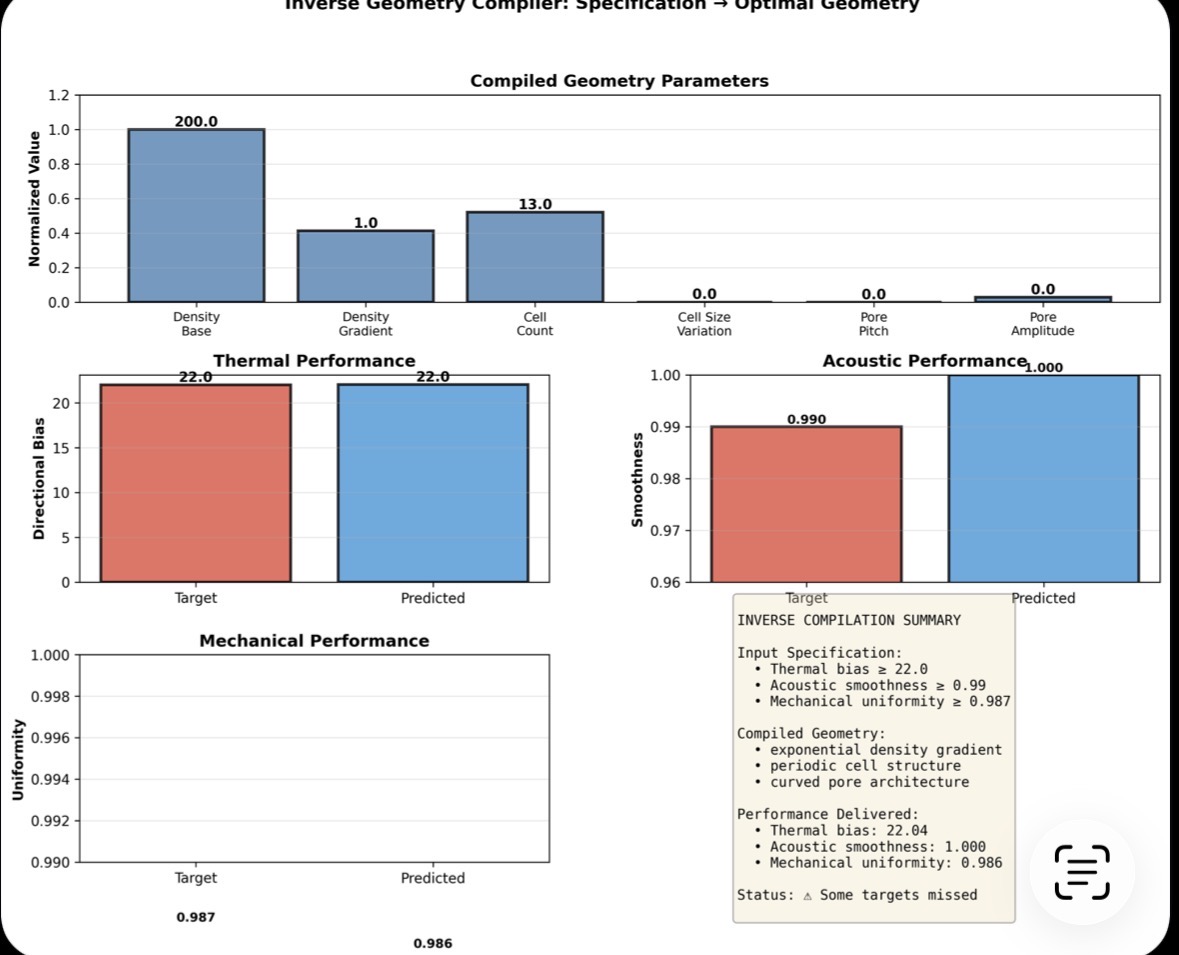
Instead of tuning materials one domain at a time, we can now specify performance envelopes across domains and generate internal geometry that satisfies them simultaneously.
Thermal routing without pipes. Acoustic smoothing without damping mass. Impact distribution without rigid reinforcement.
No added systems. No stacked layers. No chemistry changes required.
⸻
From Trial-and-Error to Compilation
- Pick a material
- Test it
- Add compensating layers
- Iterate until compromises are acceptable
That process is slow, expensive, and fragile.
We're building something different:
A geometry compiler.
- directional heat flow
- vibration isolation
- load distribution
- weight limits
- thickness constraints
The system outputs a manufacturable internal geometry that satisfies the full set of requirements at once.
This isn't simulation software. It's inverse design.
⸻
Why This Matters Across Industries
If you work in any environment where multiple physics interact, this changes how problems get solved.
Battery systems that need thermal routing and vibration control. Protective equipment that must distribute impact without trapping heat. Aerospace structures balancing cryogenic insulation with launch loads. Medical devices where mechanical stability, acoustics, and thermal behavior overlap.
These are not material problems. They're trajectory problems.
And geometry is the control surface.
⸻
Why We're Sharing This Now (and Carefully)
We're not announcing a product today.
We're sharing a design principle that's reshaping how we build inside Embera—because the people who will benefit most from this approach are often the ones forced to compromise the hardest under current tools.
The deeper technical work exists. Physical validation is underway. The platform is being built deliberately.
For now, the goal is simple: Change how people think about what's possible when geometry—not chemistry—leads the design.
⸻
The Shift Ahead
Material science has spent decades optimizing substances.
The next leap isn't smaller pores or better additives. It's programmable structure.
When geometry becomes the primary design language, materials stop being passive. They start behaving like systems.
That's the direction we're building toward.
Quietly. Deliberately. And with a lot more ahead.