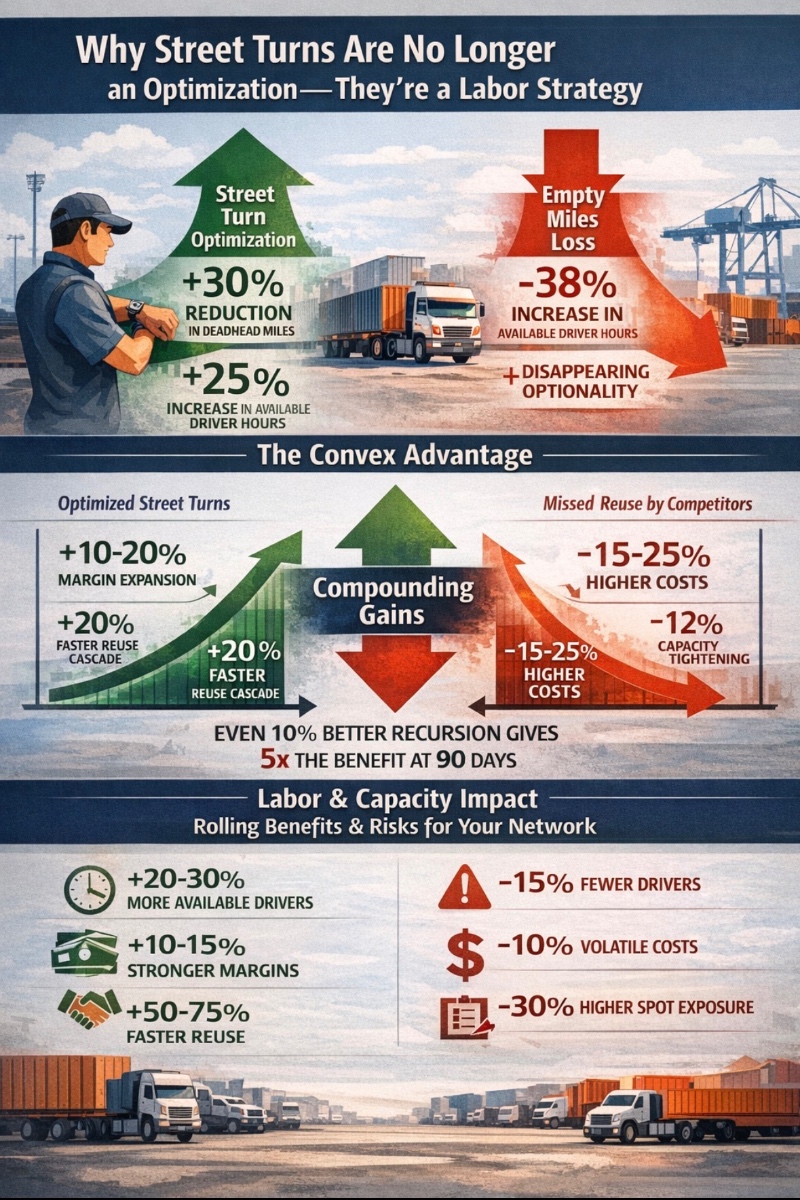
Why Street Turns Are No Longer an Optimization — They're a Labor Strategy
Street turns are still discussed as a throughput or cost tactic.
That framing is outdated.
In a market where qualified driver labor is structurally constrained, street turns are no longer about efficiency.
They are about preserving human capacity inside a system that no longer has slack.

⸻
The Labor Constraint No One Models Correctly
Most networks treat driver availability as an input.
In reality, it behaves like a hard constraint with delayed feedback.
- Each empty mile doesn't just cost money
- It consumes irreplaceable driver time
- That time cannot be replenished on demand
- And its loss propagates across future moves
Optimizing street turns isn't about saving miles.
It's about protecting labor time from irreversible waste.
⸻
Why Street Turns Change the System Epistemically
A single street turn reduces one empty move.
A recursively optimized street turn changes what the system knows is possible.
- Stops assuming empty repositioning will be available later
- Preserves drivers for revenue-generating moves
- Avoids scheduling decisions that require slack that no longer exists
This is epistemic optimization: The system updates its beliefs about future capacity before reality forces it to.
⸻
Recursive Prediction Turns Labor into a Convex Asset
- Labor loss is linear
- Savings are local
- Gains are easily matched by competitors
- Preserved labor compounds across days
- Reduced empty miles free drivers before they are needed
- Downstream congestion is avoided rather than absorbed
- The benefit grows faster than the effort invested
That's convexity.
⸻
The Asymmetric Advantage Most Networks Miss
Here's the critical point:
Street-turn recursion doesn't just help you.
It harms competitors who don't see it early.
- Reuses containers earlier
- Pulls drivers forward into productive moves
- Consumes fewer empty repositioning slots
- Lose access to the same labor pool
- Experience tighter availability
- Pay higher premiums for recovery
- Suffer volatility later in the week
The advantage isn't shared.
It's asymmetric.
⸻
Why This Is Already Showing Up in the Market
- Commit fewer drivers defensively
- Avoid over-promising during compression
- Maintain service stability without price spikes
- Appear "lucky" when the week tightens
- Sudden labor gaps
- Forced reassignments
- Higher spot exposure
- Explanation calls that arrive too late
This isn't execution quality.
It's epistemic positioning.
⸻
What Street-Turn Optimization Really Buys You
- Reduce deadhead miles and labor burn
- Preserve driver availability for high-value legs
- Stabilize service under pressure
- Shift competitive dynamics quietly
- Create benefits competitors only notice after they've lost them
This isn't throughput optimization.
It's capacity control under constraint.
⸻
Closing
In a labor-constrained market, every empty mile is a strategic decision.
Optimizing street turns without recursion saves money.
Optimizing them with recursion reshapes the network — and the labor market around it.
By the time competitors react, the advantage has already compounded.
And in systems governed by time and labor, late recognition isn't neutral.
It's expensive.