Preventing "Mass SOS Day"
A Tessellated Network Architecture for Resilient Cellular Systems
⸻
Abstract
Recent nationwide cellular outages—characterized by widespread devices falling into "SOS only" mode—demonstrate a structural failure mode in modern telecom architecture. These events are not primarily caused by radio failure, tower loss, or device malfunction. Instead, they arise from centralized authentication and provisioning topologies that collapse globally when a small number of core dependencies degrade.
This article introduces a tessellated network architecture—validated through failure-propagation simulation—that replaces single-core dependency with local closure, quorum identity, and bounded fallback operation. The result is not the elimination of outages, but the prevention of total collapse. Networks degrade gracefully rather than snapping to zero.
⸻
1. The Structural Failure Mode
Modern cellular networks are geometrically centralized.
- authentication services (HSS / UDM),
- provisioning systems,
- and core routing endpoints.
- radios are functional,
- towers are broadcasting,
- and backhaul is intact.
The observable result is mass SOS mode, a binary failure that treats all users as untrusted simultaneously.
This is not a capacity problem. It is a topology problem.
⸻
2. Simulation Overview: Centralized vs Tessellated
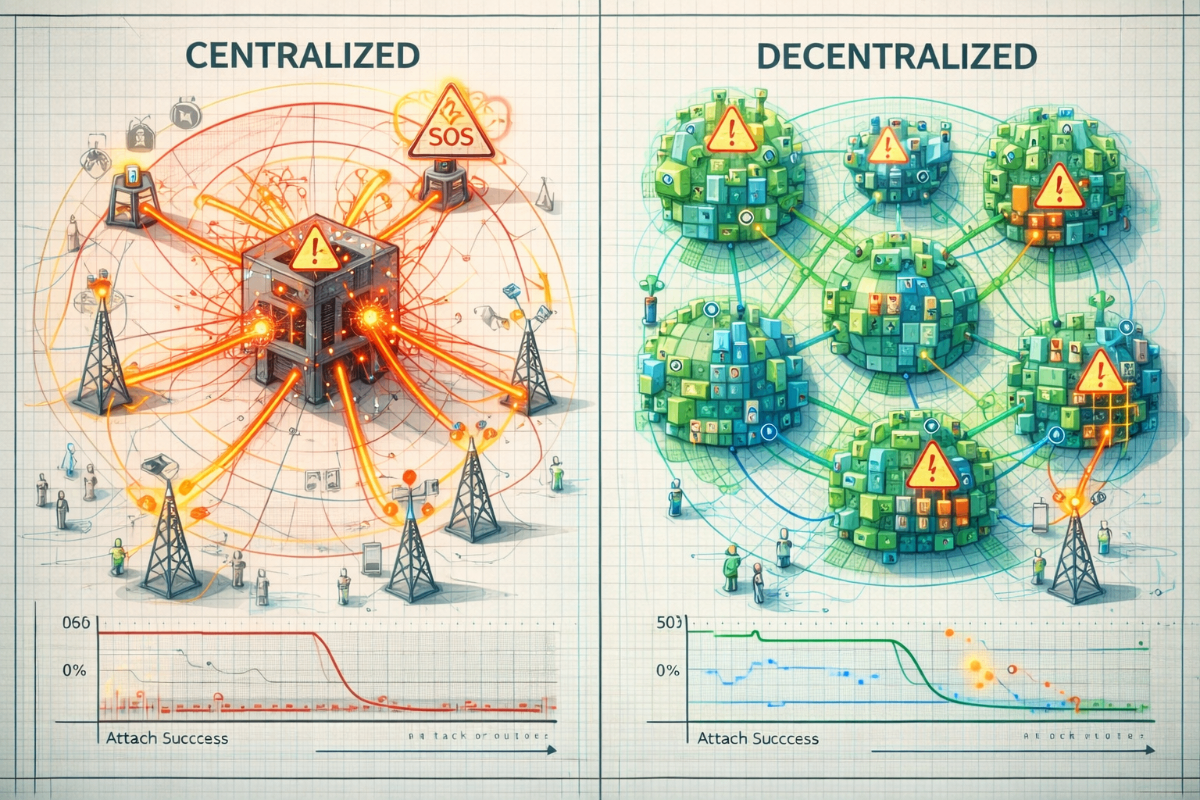
- Centralized architecture: hub-and-spoke attachment through single core auth and routing services.
- Tessellated architecture: regional edge cores, quorum authentication, and redundant perimeters.
Both systems were subjected to the same disturbance window (intermittent auth and routing failures).
- Centralized system: attachment success collapses to ~0% whenever a core dependency fails.
- Tessellated system: attachment success degrades smoothly, remaining partially operational throughout the disturbance.
The tessellated network never fully collapses—even under sustained stress—because no single failure invalidates all devices at once.
This behavior mirrors classical physical systems with local closure and distributed load paths.

⸻
3. Design Primitives for a Resilient Cellular Network
1) Local Closure: Edge Core Registration
Problem Phones must attach to a distant national core. If it fails, entire regions go dark.
- Voice
- SMS
- Limited data
- Emergency coordination
If the global core is unhealthy, devices attach locally until full service returns.
Geometric idea Cells that close locally, rather than relying on a single center. Think: autonomous islands, not dependent spokes.
⸻
2) Quorum Authentication: "3-of-7" Identity Validation
Problem A single broken dependency blocks all device attachment.
- Device presents:
- Any 3 of 7 independent regional verifiers approve attachment.
- If one verifier or region is down, quorum still holds.
Geometric idea Polygon stability: remove one vertex, the shape remains intact.
⸻
3) Graceful Degradation Contracts: Fallback Entitlement Cache
Problem When core auth is unavailable, networks treat everyone as untrusted → SOS.
- "This SIM was valid within the last 72 hours"
- Permit:
- Enforce:
No total denial.
Geometric idea Continuity under pressure. The system compresses into a smaller operating envelope instead of snapping to zero.
⸻
4) Multi-Carrier Safety Rail: Cooperative Roaming Mode
Problem When one carrier fails, users lose everything.
- If Carrier A's core is unhealthy:
- Only essential services
- Automatically unwinds on recovery
Geometric idea Redundant perimeters. Multiple walls, not one.
This is politically difficult—but technically straightforward.
⸻
5) Device-to-Device (D2D) Mesh as a Control Plane
Problem When towers and cores disagree, devices become isolated.
- time synchronization,
- emergency coordination,
- attach guidance (where service exists).
Not a data plane. A coordination field.
Geometric idea Field continuity. Even when large nodes fail, the local graph remains connected.
⸻
6) Attach Budgeting & Shock Absorbers
Problem When service returns, millions of devices reattach simultaneously → cascading failure.
- randomized backoff,
- priority tiers,
- regional pacing (X attaches per second).
Geometric idea Load wave damping. Turn spikes into smooth curves.
⸻
7) Health-Gated Routing: Anycast with Circuit Breakers
Problem Traffic routes to unhealthy cores because "that's the configured endpoint."
- anycasted,
- continuously health-gated.
- traffic diverts automatically,
- or falls back to cached entitlement mode.
Geometric idea Flow follows viable paths, not static policy.
⸻
4. The Unifying Frame
Build telecom like a tessellated structure, not a single organism: local closure + quorum identity + bounded fallback entitlements + cooperative perimeters.
This does not prevent outages.
It prevents mass collapse.
Just as modern structures are designed to deform rather than shatter, resilient networks must degrade gracefully under pressure.
⸻
5. Implications - For operators: fewer nationwide failures, lower reputational risk. - For regulators: continuity without mandating impossible uptime. - For users: no more "everything to SOS" days.
The technology already exists. The geometry has simply been wrong.