HOUSE INTELLIGENCE — PUBLIC OPERATOR REPORT
# 48–96 Hour Action Window
Date: January 9, 2026 Coverage: Inland + Port-Adjacent U.S. Terminals Prepared by: Hampson Strategies — House Intelligence (NPVIS)
⸻
EXECUTIVE ACTION SIGNAL
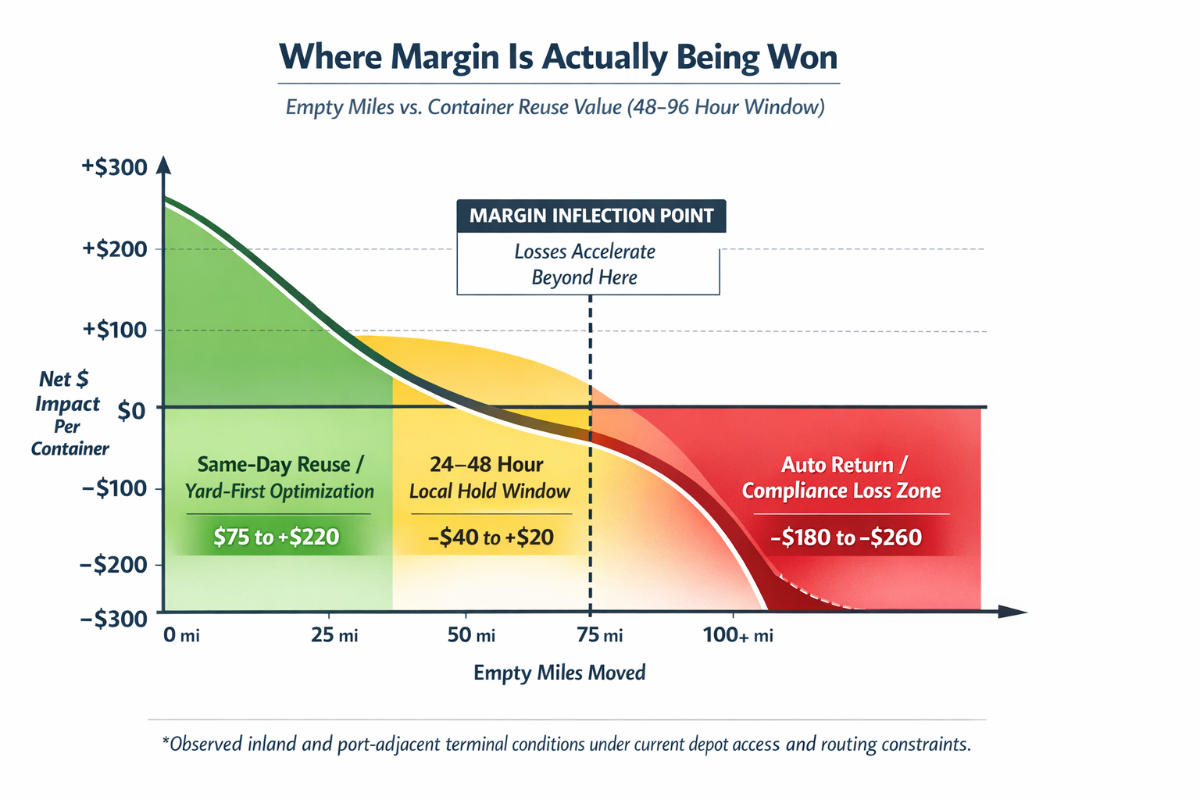
Over the next 48–96 hours, terminals and fleets that delay empty returns and prioritize local reuse will outperform by $75–$220 per container move relative to baseline contracts.
- Depot access friction
- Rail-in / truck-out imbalance
- Insurance-driven routing latency
- Mispriced empty reposition miles
⸻
SYSTEM STATUS (NOW)
Observed Conditions - Empty containers accumulating inland of ports - Import boxes dwelling 24–72 hrs longer at DCs and processors - Rail ramps releasing containers faster than depots can absorb - Drayage fleets absorbing unpriced empty miles as "operational noise"
Interpretation This is not congestion — this is misaligned container ownership timing.
⸻
ACTIONABLE OPPORTUNITY #1 — STREET TURNS
Probability: HIGH Execution Difficulty: LOW Time Sensitivity: IMMEDIATE
What to Do - Hold empties locally for 24–48 hrs instead of auto-routing to depots - Offer same-day turn availability to nearby exporters, reloaders, and shippers - Prioritize consignee-to-shipper handoffs over depot returns
Why It Works - Depot appointment scarcity inflates empty reposition miles - Local shippers are already asking for equipment — quietly - Every avoided empty return saves 40–120 deadhead miles
Operator Metric
If an empty moves more than 35 miles without revenue, the turn was missed.
⸻
ACTIONABLE OPPORTUNITY #2 — RAIL RELEASE TIMING
What to Watch (Next 72 hrs) - Rail ramps accelerating unload windows - Chassis availability briefly improving before tightening again
What to Do - Pull imports early in the window - Pair rail pickups with pre-identified reload candidates - Avoid overnight dwell that forces depot routing the next morning
Why It Works
Rail velocity is temporarily outrunning depot throughput. This creates short-lived container availability pockets.
⸻
ACTIONABLE OPPORTUNITY #3 — INSURANCE-DRIVEN ROUTING
Probability: MEDIUM Execution Difficulty: LOW
What to Do - Expect longer transit ETAs baked into new bookings - Do not over-rotate on "late" arrivals — they are system-wide - Focus on post-arrival utilization, not arrival precision
Why It Works
Insurance clauses are reshaping routes faster than pricing models. Operators who assume "normalization" will over-position assets.
⸻
DO NOT DO THIS (COMMON LOSSES)
❌ Auto-return empties "to stay compliant" ❌ Chase depot appointments at any cost ❌ Assume next week's volumes solve this ❌ Treat empties as neutral moves
Each of these locks in guaranteed margin leakage.
⸻
HOUSE INTELLIGENCE BENCHMARK
- Reducing empty miles by 18–32%
- Increasing same-day container reuse
- Running yard-first intelligence, not port-first
- Treating empties as revenue candidates, not liabilities
⸻
WHAT THIS REPORT IS
✔ One-time public release ✔ Immediately executable ✔ Terminal-level intelligence ✔ No software required
WHAT IT IS NOT
✘ Marketing ✘ Forecasting ✘ Theory ✘ Generic analytics
⸻
This report is already being generated privately for select terminals.
- Your terminal added
- Your yard mapped
- Your empty exposure quantified
- Your street-turn potential surfaced
Reach out directly.
We already know where to look.
— Hampson Strategies House Intelligence | NPVIS | Terminal & Yard Optimization
⸻